Monday, November 21, 2011
First winter season banding
First banding session for winter 2011 was slow but then I only had three nets up. Focus for the morning was birds coming to the bird feeders. The two White-throated Sparrows caught were both recaptures from February 2011. Always good to find migrants returning. Then there were three HY Brown-headed Nuthatches first caught in September this year. I believe the three birds are siblings. I frequently find them in each others' company.


Saturday, May 21, 2011
Wrens and ovenbirds
MAPS Period 3 report
Northern Cardinals were noticeable by their absence today. Instead Carolina Wrens were vocal and two hatch years were banded. As these fledglings were caught in the same net within an hour of each other I suspect that the birds are siblings.
The other story of the morning was two Ovenbird recaptures. The bird described below was banded in 2009 as a ASY. The second bird was banded as a ASY on June 12, 2010. With this level of site fidelity I do hope the birds are fledging young successfully and that those young survive to migrate. This forest habitat is fragmented by dwellings. The answer to this question is one that MAPS data analysts may become able to answer.

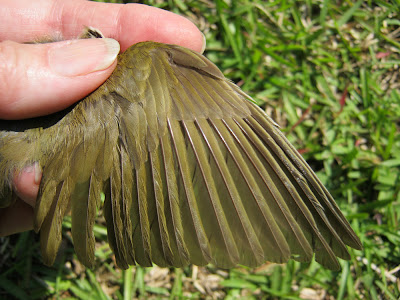
Reading a research study about site fidelity is just not the same as holding a living example in your hand. The photo above was taken on May 31, 2010. That was the second year that this particular male Ovenbird (CP) went into a mist net. Today the same bird was recaptured. The original banding was on May 24, 2009. The bird was sexed as a male each time.
 Wing in 2010.
Northern Cardinals were noticeable by their absence today. Instead Carolina Wrens were vocal and two hatch years were banded. As these fledglings were caught in the same net within an hour of each other I suspect that the birds are siblings.
The other story of the morning was two Ovenbird recaptures. The bird described below was banded in 2009 as a ASY. The second bird was banded as a ASY on June 12, 2010. With this level of site fidelity I do hope the birds are fledging young successfully and that those young survive to migrate. This forest habitat is fragmented by dwellings. The answer to this question is one that MAPS data analysts may become able to answer.

Reading a research study about site fidelity is just not the same as holding a living example in your hand. The photo above was taken on May 31, 2010. That was the second year that this particular male Ovenbird (CP) went into a mist net. Today the same bird was recaptured. The original banding was on May 24, 2009. The bird was sexed as a male each time.
 Wing in 2010.
Wing in 2011.
Sunday, May 15, 2011
MAPS period 2 report
No information on developments at the cardinal boundary line from MAPS period 2 work. Two Northern Cardinal recaptures are probably a mated pair this season. The female is one of the first birds I banded here (August 4, 2007).
Three neotropical species were banded for the first time this year: red-eyed vireo, prothonotary warbler and ovenbird. Several PROW and OVEN were calling. Actually heard a yellow-billed cuckoo too.
 Red-eyed Vireo

 Prothonotary warbler

Three neotropical species were banded for the first time this year: red-eyed vireo, prothonotary warbler and ovenbird. Several PROW and OVEN were calling. Actually heard a yellow-billed cuckoo too.
 Red-eyed Vireo
 Prothonotary warbler
There appear to be four Eastern Bluebird chicks in this nest box. Only box occupied this year so far.

Saturday, May 7, 2011
MAPS 1 - boundary war?


When two male cardinals are found in a net near each other on the same net run I suspect a dispute. When the birds got into the net during a five minute period while I checked another net I'm more certain. Add in evidence of injuries and I'm at 100%
Net 41 figured prominently in disputes for the Northern Cardinal now sporting band #82. At 7:40 this bird had an unbanded NOCA (now #81) partially in its clutches. I deduce this from feathers still clutched in its bleeding claw and the missing greater coverts on the other bird. Judging by the old gouge in the upper bill and rectrices growing in (R1 and R3) #82 is no stranger to disputes.
Then at 11:11 I find #82 back in the same net but accompanied by another NOCA male. The other male (#67) was banded as a HY in July 2010. This time the gouge in #82s beak is bleeding a little. Perhaps I'll discover who "wins" this spot later in the season.


This was not a stellar start to the MAPS season but not a bust either. One of the many vocal Great-crested flycatchers was captured, plus one of the stealth Gray Catbirds.

Sunday, April 24, 2011
This and that

Unknown nest builder. Nest is tucked into corner over front door.
 Hidden under foliage are ....
 Hidden under foliage are ....
Pink Moccasin Flowers (Cypripedium acaule)

 Redbelly Snake (found under a pot on a cold morning)
Monday, April 4, 2011
Turtle

I found this partially decayed turtle at the water's edge. There is still evidence of head, neck and legs. The tail is impressive and looks very dinosaur/prehistoric!. Eventually just the shell will remain.
There were lots of large turtles sunning on logs or the pond banks this last weekend.


Vegetable garden
 Strawberry plants went in mid march.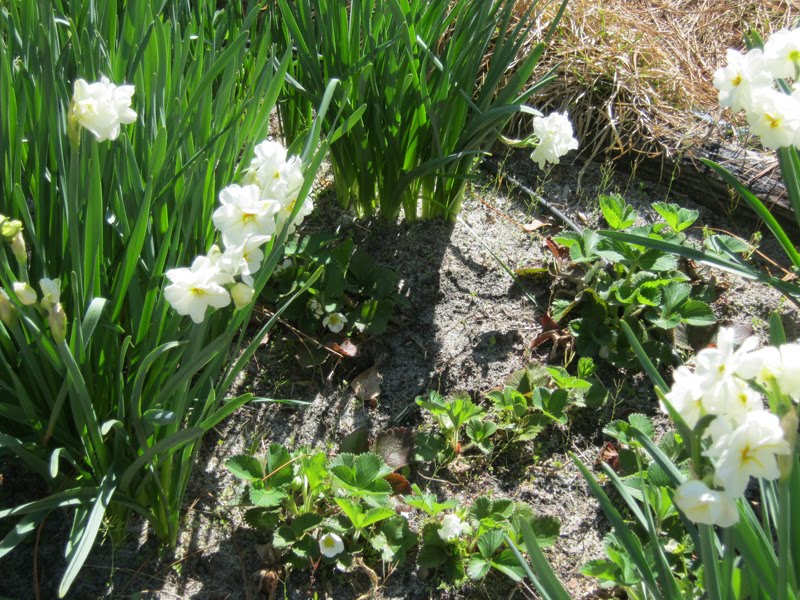
 Last year's strawberry plants growing amidst clumps of daffodils. I'll find out this year if the strawberry plants can grow and fruit okay this way. The flowers look good so far.
Young radishes.
Subscribe to:
Posts (Atom)