Monday, February 21, 2011

Pine Siskins


At a bird feeder Pine Siskins look drab -- small grayish streaked birds. When you have a bird in your hand though the yellow in the tail and wings is eye popping bright.


Saturday, February 12, 2011

Purple Finches

This winter Purple Finches are regular visitors to the bird feeders. I've counted eight at one time for Project Feederwatch, of which three were male birds based on coloration. Five Purple Finches are now banded but only one of the five is an obvious male bird (dipped in raspberry juice as they say). So either the ASY male birds are more adept at avoiding nets or there are more than eight birds coming to the feeders. Time will tell.

New species for the year banded today: ruby-crowned kinglet.

Friday, February 11, 2011

Eight species

There was a hard frost this morning so I switched banding to the afternoon. Most of the birds caught are coming for the food at the feeders. As a result I have data on birds that are year round residents. Also I'm building up a data set on white-throated sparrows. Some of the sparrows are returning each winter. My long-term goal is to compare data for this locale with the results of WTSP studies elsewhere and to check for any mini-migration movement during the winter season.

SPECIES BANDED February 11, 2011
*American goldfinch 2
*Brown thrasher 1
*Carolina chickadee 1
*Carolina wren 1
*Chipping sparrow 1
*Purple finch 1
*Yellow rumped warbler 1
*White th sparrow 2

* new species for 2011

Two recaptures: WTSP and TUTI.

Tuesday, January 11, 2011

Tracks in the snow

Snow can reveal some of the animals in your neighborhood. Here are two sets of tracks that I found this afternoon.

This first track is crossing a single lane dirt road between two water bodies.


2010 banding statistics

Outdoor activities are curtailed while snow and ice is on the ground. Hence I turn to compiling banding statistics.

The data covers too few years to uncover trends. I have noticed a change in presence/absence of several species but data for additional years is required. Then I'll also consult other data sets before reaching any inferences.

I am pleased with the variety of species banded. This station is located in a rural/suburban landscape mix. Planning authorities are approving smaller lot developments. The proportion of woodland and woodlot size is likely to diminish within a one mile radius of the station.

This year I banded more during migration. The species caught on a Friday differed from those the following Monday. This is probably an example of how species move in groups or waves. I'll look for more evidence of this.

Individual birds from both neotropical and wintering species have returned in subsequent years to this locale. None of the birds banded here have been reported as found elsewhere and I have not found a foreign recapture so information is not available on where birds may be at other times of year.

I'll continue to band whenever possible during the winter months so that data is accumulated on wintering populations. As weather patterns change, the composition of these wintering flocks may alter.

STATION 2007-2010 (3 ½ years, includes MAPS data)
Number of species banded: 59
Number of species recaptured: coming soon
Number of new bands: 555

MAPS 2008-2010 (3 summer seasons)
Number of species banded: 30
Number of species recaptured: 14

2010
2010 YEAR (includes MAPS data)
Number of species banded: 37
Number of species recaptured: coming soon
Number of new bands: 154
Number of recaptures: coming soon

Number of neotropical species banded : 15
Number of neotropical species recaptures: 3 (Ovenbird, White eyed vireo, wood thrush)

2010 MAPS
Number of species banded: 18
Number of species recaptured: 5
Number of new bands: 43
Number of recaptures: 12

Sunday, November 21, 2010

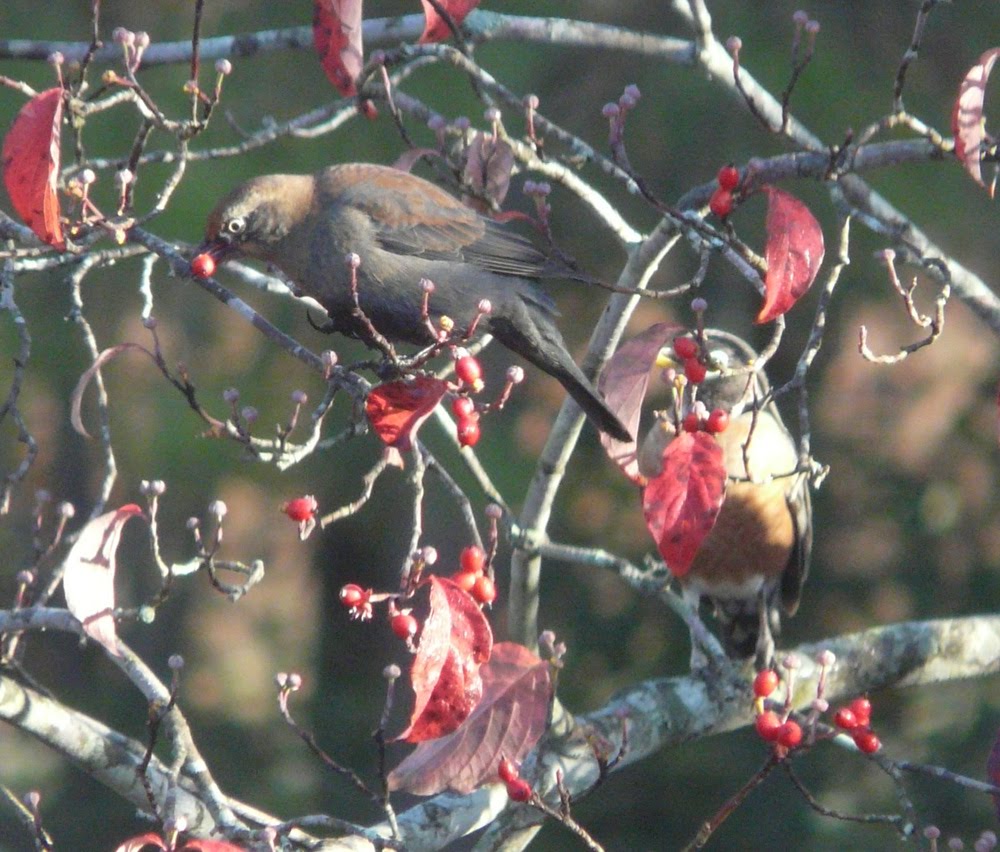
Dogwood berries and rusty blackbirds


Dogwood berries are a popular food item with the outdoor critters. As the fall progresses our anticipation of the dogwood berry feasting spectacle grows. Who will come this year? For the last month squirrels have taken some. Mockingbirds appeared and began guarding trees. Then in mid November robins descended and began munching.

We speculate on what brings on the invasion. Are the berries "ripe" enough? Does a roaming flock come through the area and eats what it finds? I suspect the answer is the latter as everyone's trees are stripped at different times. Then there are berries on other tree species that remain untouched.

This year there were lots of American Robins, a few mockingbirds, some Northern flickers showing off those golden feathers and a few Rusty Blackbirds. No starlings or grackles were seen at the trees this season.


One of the blackbirds was caught in a mist net and so I obtained the close up photographs of the exquisite rusty edgings on feathers. The detail is rarely visible when a bird is viewed through binoculars amongst leaves in the uneven lighting of a tree.


Wednesday, October 6, 2010

Big Bald Mountain banding station

A fall migration banding station operates on Big Bald Mountain. I spent an informative two days visiting at the station in September. Tennessee warbler is the most common bird at this time of year. Some of the other species banded during my visit were Swainsons Thrush, Cape May warbler, and Blackpoll warbler.


Furled nets in morning drizzle


Station is in the low trees at the top of this bald.

Open net


Hawk watch station in distance.


This Whimbrel was an unusual visitor at the hawk watch station. This photograph was taken on September 18th. The bird was seen on the 16th as well.